Skip to content
Sign in

Download Grade 9 Schemes of Work 2025 (All Subjects) – KICD Aligned & Editable

As Junior Secondary School transitions to the final phase, having the right Grade 9 CBC Schemes of Work is critical for effective syllabus coverage. These schemes are fully aligned with the latest KICD rationalized curriculum designs for 2025, covering Term 1, 2, and 3.

​At Creatorz.co.ke, we provide fully editable, professionally prepared schemes of work for all Grade 9 learning areas. These documents are designed to save you time and ensure 100% syllabus coverage for Term 1, Term 2, and Term 3.

Why Use Our Grade 9 Schemes of Work?

​Preparing schemes from scratch can take days. Our ready-made resources offer:

  • ​Rationalized Content: Fully aligned with the 2025 KICD curriculum changes (e.g., merged Agriculture & Nutrition).
  • ​Editable Formats: Available in Microsoft Word (.docx) for easy customization of school name and TSC details.
  • ​Comprehensive Structure: Includes Lesson Learning Outcomes, Key Inquiry Questions (KIQs), Core Values, and Assessment Rubrics.
  • ​2025 Calendar Aligned: Tailored to fit the official 13-week Term 1 schedule.

Grade 9 Learning Areas (Term 1, 2025)

​Below is the list of official Grade 9 subjects you can download. Click on any subject to access the download locker.

​Core Subjects

  1. ​Mathematics – Focuses on algebraic expressions and geometric constructions.
  2. ​English – Emphasizes functional writing and critical literacy.
  3. ​Kiswahili – Covers “Lugha,” “Fasihi Simulizi,” and “Insha.”
  4. ​Integrated Science – Merges Biology, Chemistry, and Physics concepts.
  1. ​Social Studies – Covers Kenyan history, citizenship, and global awareness.
  2. ​Pre-Technical Studies – (Merged Business, Computer, and Technical studies).
  1. ​Agriculture & Nutrition – (Newly merged learning area).
  1. ​Creative Arts & Sports – (Merged Physical Education and Performing Arts).

Try our free ai video generator and image generator tool

How to Download Your Schemes of Work

​To maintain our servers and continue providing high-quality AI tools for Kenyan teachers, some of our premium professional documents require a small access fee.

  1. ​Select your Subject: Browse the list above.
  2. ​Unlock the Locker: Click the download button. You will be prompted to enter your M-Pesa number.
  3. ​Automatic STK Push: You will receive a prompt on your phone for KES 50.
  4. ​Instant Download: Once payment is confirmed, the download link will appear instantly on your screen.


How to Prepare CBC Schemes of Work in Kenya 2026

In Kenya’s new education system, the Competency Based Curriculum (CBC schemes of work), teachers need to be well organised so as they can deliver as recommended by Kenya institute of curriculum development. One important document that any teacher must have is the Scheme of Work. This  is not just  paperwork for the headteacher. It is your teaching guide on a daily basis. It helps you deliver lessons that build real learner skills.

Sample CBC Scheme of Work 2025
Schemes of work

​What Schemes of Work Mean.


​CBC Schemes of Work differ from the old 8-4-4 system in many ways.CBC schemes of work do not focus on what the learner memorizes but rather what the learner does. A scheme is a termly plan. It breaks the KICD Curriculum Design into weekly and daily learning sessions.

For Creative Arts and Language lessons, you can use this free AI story book generator to create custom reading materials that align perfectly with your sub-strands.

​Important Parts That A Scheme Of Work Must Have.

​For approval by TSC and effective teaching, include these parts.

  • ​Strands and Sub-strands: These replace topics. Under 8-4-4 curriculum these were Topic and sub-topic respectively. These are what the learner covers at a certain day and certain period of the day. Means content to be covered .
  • ​Learning Outcomes: Defines what the learner should do by the end of a particular lesson.
  • ​Key Inquiry Questions: They are probing questions that makes learner think imaginatively.They are guide thinking. They help learners to explore and solve problems.
  • ​Learning Experiences: Things that learners must do during the lesson. Examples include group discussions and field tasks.
  • ​Learning Resources: Show materials that a teacher/learner will use throughout the learning process. Examples include textbooks, digital tools, and local items.
  • ​Assessment: Helps the teachers to know the progress of each learner.A teacher can track each learner’s progress.

​Steps to Prepare Strong CBC Schemes of Work.

Sample CBC Scheme of Work 2025
Schemes of work


​Step 1. Use the KICD Curriculum Design

You need the official Curriculum Design from KICD for every  the every learning area. The designs are free to download.The curriculum design can be said as the foundation. It is advised to Use the current version.

To ensure you are aligning your content with the right government standards, you must refer to the official guidelines. You can easily access and visit the official KICD website here to download the latest Curriculum Designs for 2025.

​Step 2. Follow the School Calendar

Check the Ministry of Education calendar. Count teaching weeks. Include half-term breaks and public holidays. This makes your work realistic.

​Step 3. Include 21st Century Skills

Plan activities that build collaboration, communication, critical thinking and other co competencies as recommended by The CBC curriculum.

​Step 4. Add a Reflection Section

After teaching, note what worked and what did not. Decide if revision is needed. This makes your work easier during.

Don’t work harder than you have to. Technology is here to make our lives easier as educators. If you are pressed for time or tired of the manual typing, use our CBC scheme generator tool to create fully customized Schemes of Work for any grade or learning area in just a few clicks.

​Benefits of Well-Planned Schemes of Work.

  • It ​Reduces stress: You teach with confidence and clarity.
  • ​Clear assessment: It becomes easier for any teacher to design each learner’s rubrics.
  • ​Time management: As a teacher you will finish the syllabus on time without last minute pressure.

​Final Notes.

​Preparing CBC Schemes of Work is a professional duty. It makes teachers work easy. It supports both teacher growth and learner success. In 2025, teachers should use technology and creative methods to keep lessons engaging. The main goal of CBC is to learners handle real life with practical skills.

Writing Prompts for ChatGPT as a Kenyan Creator

​Writing prompts for ChatGPT  Kenya creator requires a blend of technical clarity and local context to ensure the AI provides relevant, high-quality results Humanize this sentence to fit Kenyan context,
If you’re a Kenyan creator using ChatGPT, you know that generic prompts just don’t cut it. To get results that actually feel like home, you have to mix clear instructions with a bit of local soul.. Whether you are a teacher in Murang’a drafting a lesson plan or a digital marketer in Nairobi, the way you “talk” to the AI determines the value you get back. Many users struggle with “shallow” outputs because they fall into common traps that hinder the AI’s ability to understand the Kenyan landscape.


​1. Being Too Vague with Your Instructions(writing prompts for ChatGPT).

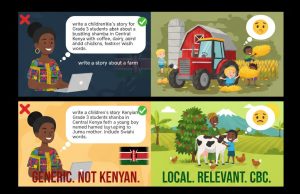
Comparison of a generic AI prompt versus a localized ChatGPT prompt for a Kenyan Grade 3 CBC story about a shamba
Notice how adding ‘shamba’ and ‘CBC’ completely changes the AI’s output quality.


​One of the most frequent mistakes to avoid when writing prompts is providing one-sentence instructions. For instance, asking ChatGPT to “write a story about a farm” will result in a generic American-style farm with corn and tractors. When you’re too vague, the AI misses the mark. For us in Kenya, generic prompts usually mean content that feels ‘foreign’ and totally out of touch with our local vibe.,Let’s be honest: generic prompts lead to generic results. If you aren’t specific, the AI misses the Kenyan vibe entirely, leaving us with content that feels out of place.. Instead, you should describe the setting: a small-scale shamba in Central Kenya with coffee trees and dairy cows. Providing the AI with “Persona” and “Goal” is the secret to professional results.


​2. Ignoring the Kenyan Curriculum and Cultural Context.


​If you are using AI for educational purposes, writing prompts for ChatGPT as a Kenyan creator without mentioning the CBC (Competency-Based Curriculum) is a recipe for disaster. Because the AI was trained on information from all over the world, it often defaults to US or UK slang and ways of doing things. If you want answers that feel Kenyan, you usually have to guide it back home.. Creators often forget to explicitly tell the AI to follow KICD guidelines or use Kenyan English spellings. To fix this, always include your target audience in the prompt, such as “Grade 4 students in a Kenyan primary school.”

Try our ai video and image generator tool


​3. Neglecting the ‘Step-by-Step’ Prompting Method(writing prompts for ChatGPT).

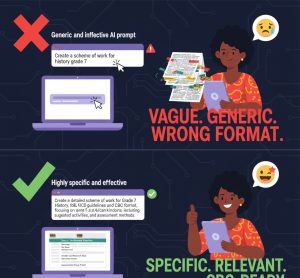
A Kenyan teacher using a structured blueprint to write effective ChatGPT prompts for CBC lesson plans and school documents.


​When writing prompts for ChatGPT, many creators try to get the final result in one go. This is a mistake known as “Single-Turn Prompting.”Don’t try to feed the AI the whole meal at once. It performs much better when you give it one task at a time, like building a house brick by brick. If you want a full scheme of work, start by asking for the breakdown of strands and sub-strands first.Checking in with the AI as you go keeps it on track. It prevents the machine from ‘daydreaming’ and making up facts that simply aren’t true.

​4. Failing to Provide Examples (Few-Shot Prompting)


​A common mistake to avoid is expecting the AI to guess your personal style or the specific format required by the TSC (Teachers Service Commission).The AI can’t see what’s in your head. If you have a specific look or feel in mind, you’ve got to give it a blueprint to follow.If you have an old lesson plan that you like, paste it into the chat and say, “Use this format to create a new one for Grade 7 Science.” This is called “Few-Shot Prompting,” and it is the fastest way to get human-like accuracy from ChatGPT.


​5. Accepting the First Response Without Refinement.


​Finally, many Kenyan creators take the first response they get and copy-paste it immediately. This is a missed opportunity to polish the output for a local audience. You should always ask the AI to “Make it more conversational” or “Add local Kenyan proverbs to make it more engaging.” Treat the AI as a junior assistant, not a final authority. 

When generating educational content, it is vital to ensure your prompts align with the KICD curriculum standards, as this ensures the AI-generated material is actually usable in a Kenyan classroom.

​If you find it difficult to structure these complex instructions manually, you can use our Free AI Prompt Generator which is already optimized to handle the heavy lifting for you.

Understanding how to communicate with Large Language Models is a key part of digital literacy in the AI era, helping creators worldwide stay competitive in an evolving job market.

About Author


How To Create A Highly Effective Schemes Of Work ( Step By Step Guide)

A scheme of work (sow) is the backbone of great teaching. In Kenya, it’s more than just a requirement—it’s your roadmap for ensuring every learner achieves their full potential within the curriculum’s timeframe.

​If you’ve ever felt rushed towards the end of a term or unsure if you’ve covered all the critical areas, this guide is for you. We will walk you through, step by step, on how to create a truly highly effective Scheme of Work that saves you time and guarantees maximum learning impact.

​1. What Exactly is a Scheme of Work (SOW)?

​Before we dive into the creation process, let’s clarify what a Scheme of Work is, especially in the Kenyan context.

​A SOW is a detailed plan outlining what you intend to teach, when you will teach it, and how you will assess it over a specific period (usually a term, a semester, or a full academic year). It translates the national curriculum or syllabus into a practical, week-by-week strategy for your classroom.

​A highly effective Scheme of Work goes beyond a simple checklist; it is a thoughtful document that links learning outcomes, content, teaching methodologies, and resources.

​2. Step 1: Lay the Foundation (Gather Your Core Documents)

​Every great structure needs a strong foundation. Before you put pen to paper (or fingers to keyboard), you must have the right tools.

Try our free video generator and image generator tool

​2.1. Get Your Curriculum Design

​Your SOW must align perfectly with the mandated educational goals.

  • ​Primary Source: Have the official curriculum design (for your learning area and grade level) from the Kenya Institute of Curriculum Development (KICD) or the relevant examination body ready.
  • ​Identify Goals: Clearly list the general objectives for the whole course and the lesson learning outcomes you are targeting. This forms the educational “why” behind your content.

​2.2. Know Your Timeframe

​You cannot create an effective Scheme of Work without a calendar.

  • ​Determine Weeks: Count the total number of teaching weeks in the term or year you are planning for. Be sure to subtract holidays, half-term breaks, national holidays, and major school events (like sports day or parents’ meetings) that disrupt class time.
  • ​Allocate Time: Roughly estimate how many weeks you think each major topic will require.

​3. Step 2: Structure Your SOW (The Core Components)

​A highly effective Scheme of Work follows a standard, logical format. You need columns to organize your thoughts and ensure all key elements are considered.

​3.1. Week/Lesson Number

  • ​Detail: Start with a column for the sequential week of the term (Week 1, Week 2, etc.). Some teachers prefer to break it down further into specific lessons (e.g., 1.1, 1.2, 1.3).

​3.2. Strands/Sub-Strands

  • ​Detail: List the specific knowledge, skills, or concepts that will be taught to help learners achieve the SLOs. This is the “what” of your lesson. Ensure this content is accurately sourced from the approved curriculum.

​3.3. Lesson Learning Outcomes (SLOs)

  • ​Detail: This is the most crucial part. What will the learner be able to do by the end of the lesson or week? Use action verbs (e.g., “Learners will be able to explain the causes of the Mau Mau uprising,” or “Learners will be able to calculate the area of a triangle”).

​3.4. Key Inquiry Questions(KIQ)​

Key inquiry questions on a scheme of work are the central, open-ended questions that frame and drive the entire learning process for a specific unit or topic. They are designed to:

  • ​Spark Curiosity and Engagement: They ignite students’ interest and motivate them to investigate and explore the content.
  • ​Focus the Learning: They provide a clear purpose, guiding students and the teacher on what the unit is essentially about.
  • ​Encourage Critical Thinking: They move students beyond simple recall of facts (surface learning) towards deeper analysis, evaluation, and application (deep learning).

​ Characteristics of Effective Inquiry Questions

​An effective key inquiry question is generally:

  • ​Open-Ended: It does not have a simple “yes” or “no” answer, or an answer that can be quickly found in a textbook. It requires sustained investigation and evidence to form a response.
  • ​Compelling/Debatable: It often presents a challenge, a dilemma, or requires students to take a position and justify it.
  • ​Connected to Concepts: It links the specific content to broader concepts and real-world relevance.
  • ​Clear and Simple: It’s phrased in a way that students can understand and share, acting as a “title” for the whole unit of learning.

​ Purpose and Function in the Scheme of Work

​The key inquiry question acts as the intellectual backbone of your unit plan:

  1. ​Guiding the Teacher (Planning): It helps the teacher select and sequence content, activities, and resources that directly help students formulate an answer.
    • ​Example: If the question is “To what extent has globalization benefited or harmed local cultures?”, the lessons must cover various aspects of globalization and its cultural impact.
  2. ​Guiding the Student (Learning): It provides a goal for the students’ learning journey. By the end of the unit, their final assessment (essay, presentation, project) should be a comprehensive answer to this question.
  3. ​Encouraging Different Levels of Thinking: Often, a scheme of work includes a progression of questions:
    • ​Factual Questions (What/Who/When): Focus on basic recall and comprehension. (e.g., What are the main causes of climate change?)
    • ​Conceptual Questions (How/Why): Encourage analysis and deeper application. (e.g., How do human systems influence natural systems?)
    • ​Debatable/Driving Questions (To what extent/Should/Could): Demand synthesis, evaluation, and taking a justified position. (e.g., Should developed nations bear a greater responsibility for mitigating climate change?)


​3.5. Lesson Learning Outcomes

  • ​Detail: How will you engage the students? Be specific. Instead of just writing “Discussion,” specify: “Group discussion on the impact of poor sanitation” or “Role-play scenario demonstrating proper customer service.” This is where you bring your SOW to life.

​4. Step 3: Integrating Resources and Assessment

​This step transforms a good SOW into a highly effective Scheme of Work by linking teaching to materials and checking for understanding.

​4.1. Resources and Reference Materials

  • ​Detail: List all the materials you will need for the week. This is an organizational lifesaver! Include textbooks (with page numbers), charts, models, digital materials (like specific YouTube clips or websites), or simple aids like manila paper and markers. Don’t wait until the night before to plan your resources.

​4.2. Methods of Assessment

  • ​Detail: How will you confirm that the students have actually achieved the Learning Outcomes? Assessments should be varied:
    • ​Formative: Observation, Q&A sessions, quick quizzes, short assignments, or oral presentations.
    • ​Summative: End-of-unit tests, projects, or main examinations.
  • ​Record Keeping: Note down where you will record the results of your assessment (e.g., “Checklist,” “Mark book entry”).

​5. Step 4: Review, Refine, and Reflect (Making it Dynamic)

​Once you have a full draft, the work isn’t over. A truly effective Scheme of Work is a living document that you revisit and adjust.

​5.1. Check for Balance and Coverage

  • ​Pacing Check: Is the content distributed logically? Are you attempting to cover too much in a single week? Overloading the SOW is a common mistake that renders it ineffective.
  • ​Curriculum Alignment: Go back to your syllabus. Have you covered all the mandatory core skills and topics? Use a simple highlighter to cross-reference your SOW against the official document.

​5.2. Reflect and Adjust

​The real test of a SOW is in the classroom.

  • ​During the Term: If a class struggles with a concept, or if a school event cuts short a lesson, you must adjust the SOW accordingly. Don’t be rigid!
  • ​After the Term: At the end of the term, review your SOW. Which activities were successful? Which topics took longer than expected? Use these notes to create an even more highly effective Scheme of Work for the next cohort. This continuous improvement cycle is what separates good teachers from great ones.

​Conclusion: Your Roadmap to Teaching Success

​Creating a highly effective Scheme of Work takes effort initially, but the payoff is immense. It provides clarity, reduces stress, and ensures that your teaching is focused, progressive, and purposeful. By following these four steps—from laying the foundation to continuous refinement—you will build a solid plan that drives exceptional student learning outcomes term after term.

​Would you like me to help you draft some Specific Learning Outcomes for a particular subject and grade to kick-start your SOW, or should we move on to drafting the final meta description?

Privacy Notice · Terms of Use · Refund Policy · Child Safety Policy
We care about children's safety and never sell data.